How to Read a Turnitin Report: Similarity Score, Match Groups and AI Score Explained
A Turnitin report looks like a wall of colours and percentages, but it only answers two questions: how much of your paper matches existing sources, and how much of it reads as AI-written. This guide shows you how to read a Turnitin report section by section, using a real sample, so you know which numbers matter and which ones do not.
Follow along with a real Turnitin report
Open the two sample reports below and keep them beside this guide. They come from the same 24-page paper: 1% similarity, 51% AI.
Screenshots shown for illustration. Your own reports arrive as full PDFs in your dashboard.
Part 1: Reading the similarity report
1. Overall Similarity
The headline percentage is the share of your text that matches sources in Turnitin's databases. It is not a plagiarism score. A 20% score made of properly quoted and cited passages can be fine. A 6% score made of one uncited paragraph lifted from a classmate is not.
2. What was filtered out
Check the "Filtered from the Report" list first. If the bibliography, quotes or small matches are not excluded, your number will be inflated by text that is not a problem. In our sample, bibliography, quoted text and cited text are all excluded.
3. Match groups
The newer report sorts every match into one of four groups:
- Not Cited or Quoted: no quotation marks and no citation. Fix these first.
- Missing Quotations: very close to the source, often lightly reworded. Quote it or genuinely paraphrase it.
- Missing Citation: in quotation marks but no citation. Add the reference.
- Cited and Quoted: handled correctly. No action needed.
4. Top sources
Each source has a number and a colour that match the highlights in your text. Look at the source type:
- Internet: websites, including essay-sharing sites.
- Publications: journals, books and conference papers.
- Submitted works: other students' papers. Large matches here get the closest scrutiny.
One source above roughly 5% deserves attention even when the overall score is low.
5. Highlighted text
Scroll through the document pages. Each highlight colour corresponds to a source. Clusters of the same colour across several paragraphs suggest reliance on one source; scattered short highlights are usually common phrases.
6. Integrity flags
Turnitin checks for hidden white text, replaced characters and similar tricks. "0 Integrity Flags" is what you want to see.
What is a good similarity score?
| Score | How most markers read it |
|---|---|
| 0 to 15% | Normal for a referenced paper, if no single source dominates |
| 15 to 25% | Worth a look; often explained by quotes or standard terminology |
| 25 to 50% | Needs explanation; check uncited matches |
| 50% and above | Usually investigated |
These are common rules of thumb, not Turnitin rules. Your institution or instructor may set its own threshold.
Part 2: Reading the AI writing report
1. The AI percentage
The top figure, such as "51% detected as AI", estimates how much of the qualifying text was likely produced by a large language model. Qualifying text means long-form prose in sentences and paragraphs. Bullet points, tables and reference lists are not scored. Turnitin needs at least 300 words of prose and accepts up to 30,000 words.
2. The asterisk
If you see *% instead of a number, Turnitin detected somewhere between 1% and 19%. Turnitin does not show a figure or highlights in that range because low scores are less reliable.
3. Detection groups
- AI-generated only: likely written by an AI model.
- AI-generated text that was AI-paraphrased: likely AI-written and then run through a paraphrasing tool or word spinner. This group currently applies to English only.
4. Highlights
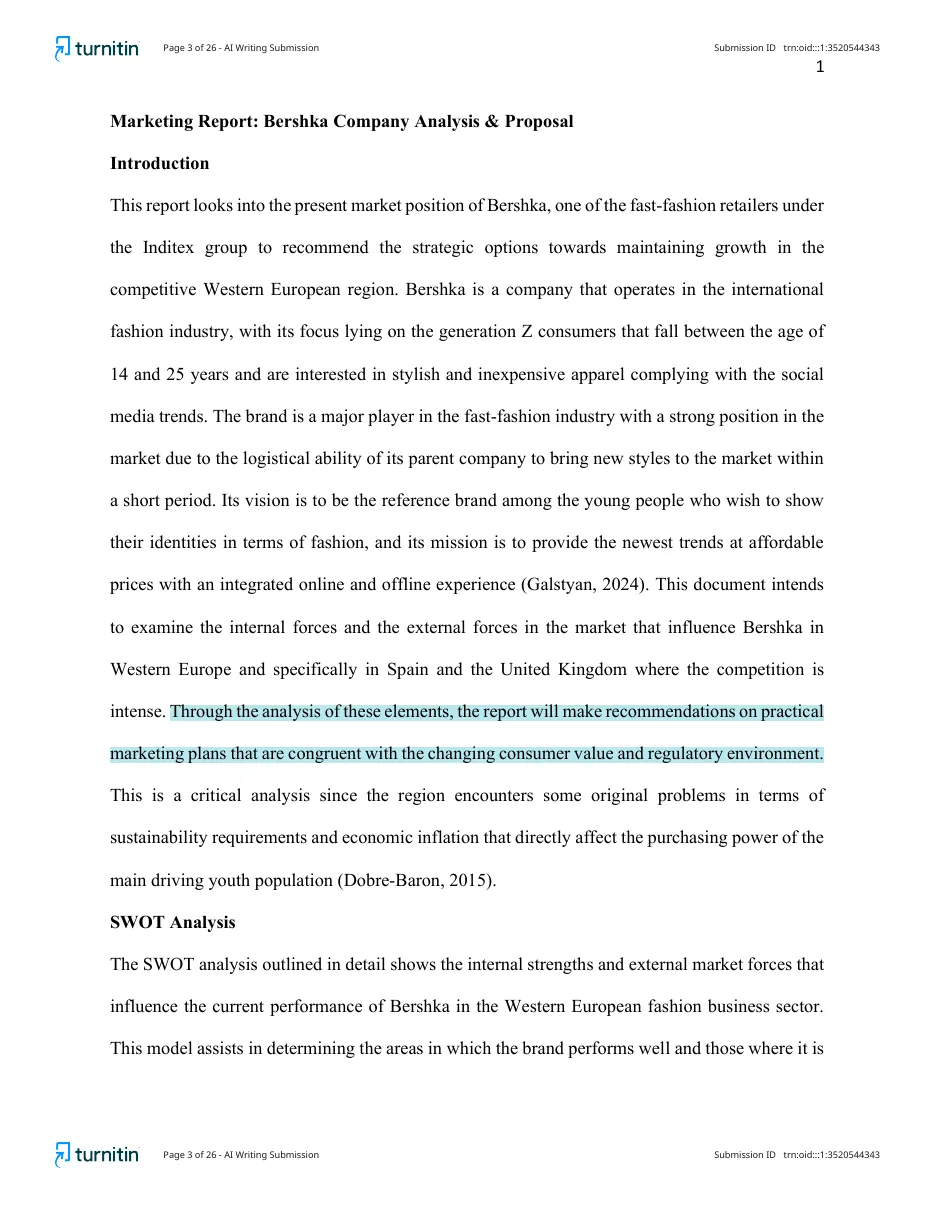
Flagged sentences are highlighted in cyan, and AI-paraphrased text in purple. Read the highlighted passages and ask whether they sound generic, overly smooth or unlike the rest of your writing. Those are the passages a marker will ask you about.
5. The limitations
Turnitin's own disclaimer says the AI score may produce false positives and should not be the sole basis for action against a student. Several universities have switched the AI detector off for exactly this reason. Still, if your institution uses it, the score will shape the conversation.
Reading both reports together
| Similarity | AI | What it usually means |
|---|---|---|
| Low | Low or *% | Original work in your own voice |
| Low | High | Original wording that reads as machine-generated (our sample) |
| High | Low | Too much copied or poorly cited material |
| High | High | Serious review likely |
Next: learn what each colour means, or see the annotated Turnitin report sample.
Frequently asked questions
What is a good Turnitin similarity score?
There is no universal pass mark. Many instructors treat anything under about 15% as normal for a referenced paper, but what matters is where the matches come from and whether they are quoted and cited.
What does an asterisk (*%) mean on the AI report?
It means Turnitin detected between 1% and 19% AI writing. Because low scores are less reliable, Turnitin shows an asterisk instead of a number and adds no highlights.
Does a high AI score prove I cheated?
No. Turnitin itself states the AI score can produce false positives and should not be the sole basis for action against a student.